Portfolios that inspired mine
A small thank-you note to the portfolios that shaped how I designed and built my own.
A quick confession
My portfolio didn’t come out of thin air.
It’s a collection of ideas I studied from multiple amazing developer portfolios.
I didn’t blindly copy everything, but I did intentionally reuse certain patterns that I felt were already well-designed and user-friendly.
This post is both a thank-you and a transparent breakdown of what influenced different parts of my site.
The Layout, Fonts, and Color System
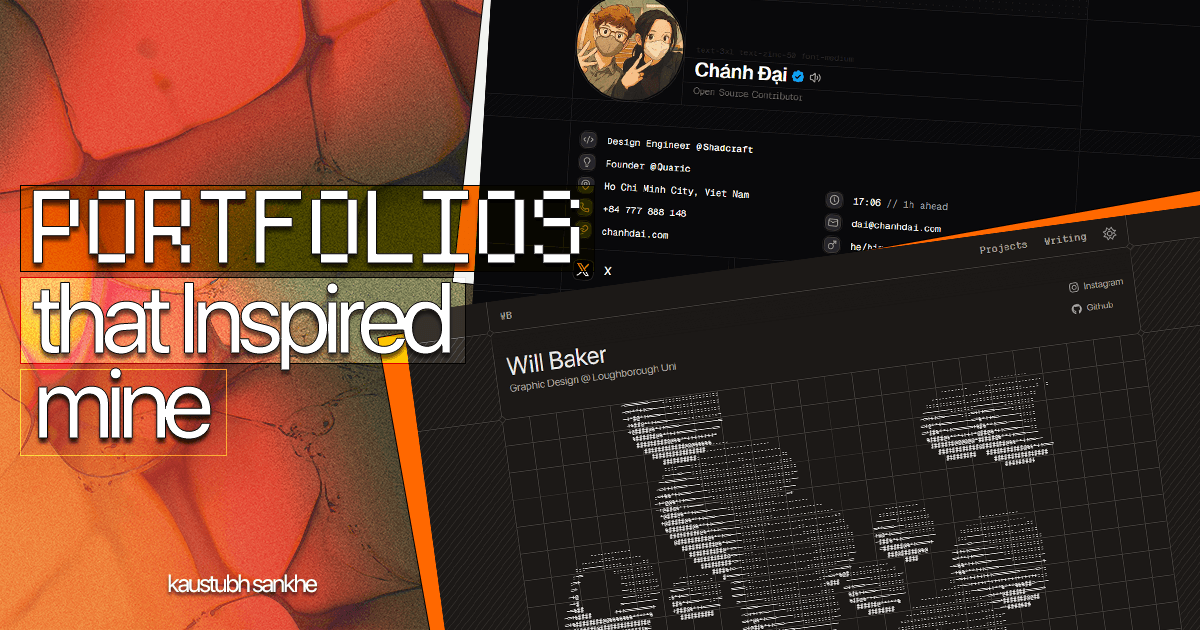
I found this portfolio by Will Baker whose layout just felt right.
The spacing, typography scale, and color palette created a very clean reading experience, so I used that as the base reference for my own structure.
What I took:
- Overall page layout structure
- Font pairing and typographic rhythm
- Core color scheme inspiration
- Project showcase layout and styling
Why I kept it:
Honestly, it just felt right. The content flowed well, headings stood out naturally, and the colors didn’t fight for attention. I didn’t have that level of intuition yet, so using that structure helped me avoid a lot of messy trial and error.
My takeaway:
You rarely notice good layout when it’s done right. You only feel the friction when it’s not.
Profile Section and SEO Approach
Another portfolio I came across by Chánh Đại handled personal info and SEO extremely well.
It was optimized, structured, and clearly designed with discoverability in mind.
What influenced me:
- Profile & overview section layout
- SEO meta structure and content placement
This helped me think beyond visuals and consider how my portfolio is indexed and presented externally.
So what's original?
While parts of the portfolio were inspired by existing work, the final result isn’t just a collection of copied pieces. Inspiration from different portfolios helped shape the direction, but a lot of the implementation, structure, and decisions happened during the process of building it.
Several sections are entirely my own design and thinking, including:
- The skills section
- The experience timeline
- The way I tell the story behind projects
These parts reflect my actual journey and how I prefer to present it, not something modeled after another portfolio.
There are also many smaller design decisions across the site that evolved naturally while building. Some patterns may have started from inspiration, but the final version usually changed as I adapted them to fit my own content, layout, and ideas.
In other words, inspiration helped me get started, but the portfolio gradually became its own thing.
And honestly, this is still a work in progress.
As I continue refining my style, more of the site will evolve into ideas that are fully my own rather than influenced by earlier references.
What did I learn from this?
This portfolio ended up teaching me far more than I initially expected.
For the first time, I implemented dark mode on my own in a project. It turned out to be more challenging than I thought, but getting it to work properly across the entire site was a great learning experience.
I also learned a lot about:
- Designing and managing complex layouts
- Thinking in a component-driven frontend architecture
- Understanding the thought process behind frontend design decisions
- Managing SEO metadata and structure
- Building a blog system with Markdown parsing and rendering
Along the way I explored several smaller details that made the site feel more polished:
- Using BlurHash for image placeholders
- Adding subtle microinteractions
- Experimenting with minimalist design principles
(although I don't think my site is minimal)
And maybe the biggest realization was this:
Copying isn’t necessarily a bad thing, as long as you're trying to understand before you paste it.
If you study why something works, how it's structured, and what problem it solves, it stops being copying and becomes learning.
The long-term plan
This current version of my portfolio is version 1.
Over time, I want to:
- Replace more borrowed layout decisions with my own experiments
- Refine the visual system to better match my personality
- Add more original interactive and content-driven sections
In short, evolve from inspired → independent.
Final note
To every creator whose portfolio influenced even a small part of mine: Thank You.
Your work became my reference material, my design guide, and in many ways, my learning playground.
And hopefully, a few iterations from now, my portfolio will inspire someone else the same way.